
WILL ROGERS MEMORIAL MUSEUM BREAKS GROUND ON LARGEST EXPANSION IN ITS HISTORY AND MARKS 91ST ANNIVERSARY WITH WREATH LAYING CEREMONY
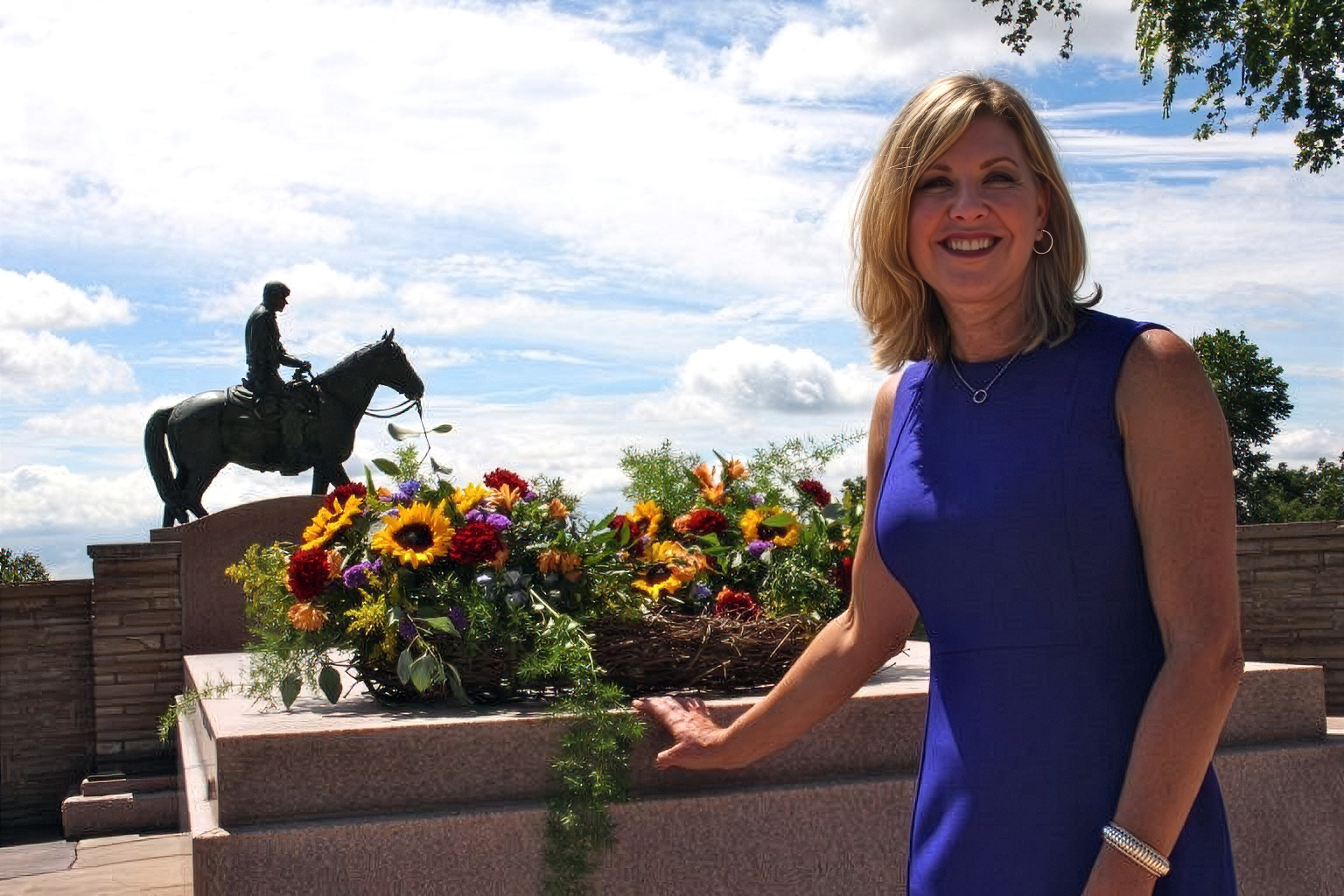
Jenifer Rogers Etcheverry, Great-granddaughter of Will Rogers, at the Will Rogers Memorial Museum
For Immediate Release
August 14, 2026 — Claremore, Oklahoma — The Will Rogers Memorial Museum broke ground on Friday, August 14, 2026, on the largest expansion and renovation in its history, followed at 1:00 p.m. by the annual wreath laying ceremony at the Will Rogers tomb marking the 91st anniversary of the death of Will Rogers, America's beloved humorist, political commentator, actor, and “Oklahoma's Favorite Son.”
A Groundbreaking 88 Years in the Making
The noon ceremony opened the museum's development and expansion program, which encompasses gardens, the memorial itself, and the surrounding outdoor spaces. Remarks were delivered by Oklahoma Lieutenant Governor Matt Pinnell, Oklahoma Historical Society Executive Director Trait Thompson, Museum Director Tad Jones, and Rogers family representative Jennifer Rogers-Etcheverry, Will Rogers' great-granddaughter.
In a moment that visibly linked the museum's past to its future, Jennifer Rogers-Etcheverry turned the first earth using the same shovel used at the museum's original groundbreaking on April 21, 1938 — when Will's sister, Sallie Rogers McSpadden, turned the first spadeful of dirt on land Will and Betty Rogers had purchased in 1911 as the site of their planned retirement home. Bob Blackburn, former Executive Director of the Oklahoma Historical Society, joined her at the site.
The project, estimated at approximately $18 million, is the largest undertaking at the Claremore landmark since the museum opened in 1938. Plans call for a new three-story, 20,000-square-foot building at the northeast corner of the property housing:
A modern, climate-controlled conservation and collections facility for the still-growing Will Rogers collection, with environmental controls replacing systems dating to the 1930s
New office space for museum staff and room for on-site research
A top-floor event center seating approximately 220 guests, with panoramic views overlooking Claremore
A traveling exhibit area enabling the museum to host larger exhibitions
The existing museum will also be renovated, with a new and larger entrance, an expanded gift shop, and accessibility upgrades throughout to meet Americans with Disabilities Act standards. A central aim of the renovation and refreshed exhibits is to present the “Will Rogers Citizenship Experience,” illustrating Rogers’ extraordinary capacity to bridge divides among people around the world.
The Oklahoma Legislature appropriated $7 million toward the work, with private donors from Oklahoma, Texas, and across the country contributing the balance. The Will Rogers Memorial Foundation continues to raise an additional $3 million for exhibits. Completion is anticipated in the spring of 2028, and the museum will remain open to the public throughout construction.
Museum Director Tad Jones described the project as the largest expansion since the building went up in 1938, and said the museum's charge is to remind people why Rogers' influence across the country still resonates. Jennifer Rogers-Etcheverry said protecting Will's artifacts in the climate-controlled environment they deserve has long been her mission. Lieutenant Governor Pinnell observed that Oklahoma can lead the way on questions of national character and identity, and that visitors can learn about it in Claremore.
Following the groundbreaking, guests were served refreshments and viewed the architectural plans and renderings for the new facility.
The Wreath Laying and Flyover
At 1:00 p.m., the solemn wreath laying ceremony took place at the Will Rogers tomb on the museum grounds, where Rogers and his wife Betty are laid to rest alongside three of their four children and other family members.
Cherokee Nation Principal Chief Chuck Hoskin Jr. delivered the keynote address, which highlighted Will Rogers' proud Cherokee heritage. Born in the Cooweescoowee District of the Cherokee Nation and known throughout his career as “The Cherokee Kid,” Rogers carried that heritage onto the vaudeville stage, into Hollywood, and across the world.
The ceremony closed with a perfectly timed flyover by volunteer docent and pilot Tom Egbert, a tradition that has become a signature of the annual commemoration.
Will Rogers and pilot Wiley Post were killed in a plane crash on August 15, 1935, near Point Barrow, Alaska. Upon hearing the news, then-President Franklin Roosevelt called Rogers an old friend, a humorist and philosopher beloved by all.
Two New Exhibits Debut
The day also marked the debut of two new mini exhibits. From Lariat to Mallet explores Will Rogers' passion for polo, examining the history and rules of the game and tracing how Rogers took it up alongside celebrities and family. A Word With Will employs new artificial intelligence technology that invites visitors to step into a 1920s phone booth and hold a simulated conversation with Will Rogers himself — a fitting tribute to a man who spent his life talking with America.
“The Call of Will Rogers” on Permanent Exhibit
Visitors to the expanded museum will continue to encounter The Call of Will Rogers, the poetic tribute written by L. M. Levie, Chairman of American Industrial Acquisition Corporation (AIAC) and the Avara pharmaceutical companies, which was installed as a permanent exhibit in January 2026.
First recited by Executive Director Tad Jones at the museum's 90th anniversary wreath laying ceremony on August 15, 2025, the poem now appears as a seven-foot enlargement holding a place of honor in the museum's Final Journey exhibit. It is displayed alongside historic Western Union sympathy telegrams sent to the Rogers family after Will Rogers' death in 1935, including messages from President Franklin D. Roosevelt, comedian Charlie Chaplin, and British Member of Parliament Lady Astor — placing the contemporary tribute in the company of some of the most notable figures of Rogers' era.
A musical adaptation of the ballad, also composed and arranged by Mr. Levie, is incorporated into the exhibit through a QR code posted beside the poem, allowing visitors to hear the tribute as well as read it. The installation arrived as the museum prepared for increased visitation during 2026's celebration of the 100th anniversary of Route 66, also known as the Will Rogers Highway.
AIAC Chairman's Remarks
AIAC and Avara Chairman L. M. Levie stated:
“A shovel that first broke this Oklahoma ground in 1938 has broken it once again, raised this time by my dear friend Jennifer Rogers-Etcheverry — proof that a family can keep a promise across four generations and nine decades of change. Will Rogers bought this hilltop for a retirement he was never granted; Betty Rogers gave it to the people of Oklahoma, so that the rest denied to one man might become an inheritance for millions. What was begun here today is not a building but a covenant: that the manuscripts and the letters, the film reels and the ropes, shall be kept as carefully as the memory they carry, and that a child who climbs this hill a hundred years from now shall meet Will Rogers as plainly as we do.
Let credit be given where history will record it is owed — to my dear friend, Tad Jones, to Trait Thompson and the Oklahoma Historical Society, to the Oklahoma Legislature, to Chuck Hoskins Jr. and the Cherokee Nation, and to the private donors who grasped that what we decline to preserve we do not merely lose, we forget. I was honored to meet Lieutenant Governor Matt Pinnell, an advocate of the Oklahoma aerospace industry, in July at the Farnborough Air Show, and it is fitting that his voice opened this day: Will Rogers was aviation's most persuasive champion, and Oklahoma has never ceased to claim him as its own.
Last year, on the ninetieth anniversary of the passing of Will Rogers, Tad recited my poetic tribute, The Call of Will Rogers at the Rogers family grave site. The museum has since honored me beyond any expectation, installing the poem permanently in the Final Journey exhibit.
It is the honor of my life to serve as Ambassador for the Will Rogers Memorial Museum. Will never asked to be remembered; he asked only to be useful. For ninety-one years this hilltop has answered him. Let it answer him for ninety-one more, and for every year beyond, until the last American in want of a laugh, a straight word,or a friend has come up this hill and found all three.”
Mr. Levie is Ambassador of the Will Rogers Memorial Museum, Donor to the Will Rogers Institute, Trustee and Poet Laureate of the Explorers Club, and Trustee of the Theodore Roosevelt Association.
Elsewhere in the Rogers Legacy
The Will Rogers Birthplace Ranch in Oologah, Oklahoma, is undergoing extensive renovation by the Cherokee Nation and is expected to reopen in the fall of 2026. In California, the Will Rogers Ranch and State Park in Pacific Palisades was largely destroyed by wildfire, though the park and polo grounds have since reopened to the public.
For further information, please see:
Oklahoma Historical Society event listing
AIAC — “The Call of Will Rogers” now on permanent exhibit
Will Rogers Memorial Museum — 2026 Expansion Plans
Will Rogers Memorial Museum tour — OHS
About Will Rogers
Will Rogers (1879–1935) was born William Penn Adair Rogers near Oologah, Oklahoma, and became one of America's most beloved entertainers and social commentators. Known for his homespun humor, political wit, and Cherokee heritage, Rogers earned the nicknames “Oklahoma's Favorite Son” and “The Cherokee Kid.”
Rogers began his career as a vaudeville performer, showcasing his rope tricks and folksy humor before transitioning to Broadway, silent films, and eventually “talkies.” He starred in more than 70 films and wrote over 4,000 syndicated newspaper columns read by millions of Americans. His famous philosophy — that he never met a man he didn’t like — reflected his genuine warmth and his ability to find common ground with people from all walks of life.
Beyond entertainment, Rogers was a passionate advocate for aviation, a philanthropist who raised funds for disaster relief, and an informal diplomat who traveled the world. His commentary on politics and social issues, delivered with humor and without malice, made complex topics accessible to ordinary Americans and helped shape American popular culture and political discourse during the 1920s and 1930s.
His life was tragically cut short on August 15, 1935, when the experimental aircraft he was traveling in with aviator Wiley Post crashed near Point Barrow, Alaska. Millions of Americans mourned, and his legacy is still remembered today.
For further information, please see:
About Jennifer Rogers-Etcheverry
Jennifer Rogers-Etcheverry is Will Rogers' great-granddaughter and serves as the family spokesperson and a passionate guardian of her great-grandfather's enduring legacy. She serves on the boards of multiple Will Rogers foundations, including the Will Rogers Ranch Foundation and the Will Rogers Memorial Foundation, where she plays a central role in strategic planning and preservation efforts.
Her involvement extends well beyond ceremonial duties. She works closely with museum staff, historians, and researchers to maintain the authenticity and accessibility of Will Rogers' extensive archives and collections, and she has been instrumental in developing educational initiatives that introduce Rogers' philosophy and humor to young people. Her deep knowledge of family history makes her a sought-after speaker at historical societies, universities, and cultural events across the country.
For further information, please see:
About the Will Rogers Memorial Museum
The Will Rogers Memorial Museum stands as a testament to the life and legacy of America's beloved humorist and philosopher. Located in Claremore, Oklahoma, on land Rogers purchased in 1911 as the site for his planned retirement home, the museum overlooks the Tiawah Valley and offers a panoramic view of Rogers State University and the surrounding countryside.
Construction of the original 15,000-square-foot limestone building began on April 21, 1938, with Will's sister, Sallie Rogers McSpadden, turning the first spadeful of dirt. After Will's death, Betty Rogers donated the property to the state of Oklahoma to establish a memorial. The museum was completed and dedicated on November 4, 1938 — what would have been Rogers' 59th birthday — with President Franklin Roosevelt participating in the dedication by radio in a tribute broadcast across the nation. An office wing, library, and theater were added in the early 1980s, and the August 2026 groundbreaking marks the largest expansion in the institution's history.
The museum's rotunda features a famous sculpture of Will Rogers by renowned artist Jo Davidson, its pedestal inscribed with Rogers' most famous quotation. The collection includes more than 18,000 photographs, thousands of original manuscripts, private letters, contracts, personal papers, motion pictures, home movies, and audio recordings. The research library contains more than 2,000 volumes covering Will Rogers and related topics including Native American history, genealogy, vaudeville, early motion pictures, and the history of the 1879–1935 era.
Originally managed by the Will Rogers Memorial Commission, the museum was transferred to the Oklahoma Historical Society in March 2016. The Rogers family tomb, located on the museum grounds, serves as the final resting place for Will and Betty Rogers, along with three of their four children and other family members.
For further information, please see:
Will Rogers Memorial Museum tour — OHS
About American Industrial Acquisition Corporation
American Industrial Acquisition Corporation (AIAC) is a diversified industrial group with manufacturing and distribution sites in 24 countries in North America, Europe, Africa, Asia, and Australia–New Zealand. AIAC has acquired and grown non-core subsidiaries and divisions of Boeing, Siemens, Lockheed Martin, Northrop Grumman, Raytheon, Johnson Controls, Merck, Pfizer, Astellas, Visteon, Carlyle, Ahlstrom, Tolko, Groupe Suez, Groupe Rexel, and many other leading multinational corporations.
AIAC companies serve companies and governmental entities worldwide in all major sectors, including aviation, space, defense, automotive, truck, rail, marine, petrochemical, solar, nuclear, food, confectionary, beverage, civil engineering and infrastructure, commercial construction, mining, dredging, disaster relief, education, medical devices, and pharmaceuticals. AIAC companies are also exclusive, authorized distributors of leading branded industrial and consumer products and serve as critical suppliers for the construction of major airports, schools, hospitals, performing arts and sports centers, offices, and hotels throughout Southeast Asia, Australia, and New Zealand. AIAC is a leading manufacturer of building, street, and highway signage in Europe, signage and illumination structures in North America, and a distributor of electrical products throughout France.
Of note, AIAC purchased Boeing Canada in 2005 and has produced over 10,000 unique components for every Boeing jet plane ever since, reliably serving Boeing from manufacturing facilities in North America. A leader in ultra-high precision jet engine component manufacturing, AIAC companies produce 2,200 fan blades for each jet engine produced by GE, Pratt & Whitney, Rolls Royce, and Honeywell.
AIAC companies actively support exploration into outer space, manufacturing critical components for launching and propelling spacecraft and satellites. AIAC customers in this sector include NASA, the European Space Agency, SpaceX, Blue Origin, and Boeing. AIAC companies also lead in the design and manufacture of undersea umbilical cables for worldwide oceanographic research.
AIAC companies produce the critical automotive wire and cable for Tesla, GM, Ford, Chrysler-Fiat, Toyota, and Nissan. In connection with its kraft paper manufacturing interests in Canada and the US, AIAC controls and sustainably manages 22 million acres of Manitoba, Canada forestland, an area equivalent in size to the nation of Hungary. AIAC affiliate Metallwarenfabrik Gemmingen GmbH, located in Germany, designs, manufactures, and distributes high performance, emergency portable power generators utilized in global conflict zones and during natural disasters.
For further information, please see:
About AIAC Philanthropy
AIAC and the AIAC Foundation support a wide range of nonprofit, nonsectarian, bipartisan organizations which promote international conflict resolution, disaster relief, economic development, environmental sustainability, exploration, and the performing arts. The exploration-focused nonprofit organizations which they actively support include the Explorers Club, the National Geographic Society, the Royal Geographical Society, the American Museum of Natural History and the Hayden Planetarium, the Victoria & Albert Museum, the National Air and Space Museum, the National Space Society, and the United States Space Foundation.
AIAC's other beneficiaries include the Appeal of the Nobel Peace Laureates Foundation Inc., the Asia Society, the Atlantic Council, the Bill and Melinda Gates Foundation – Gates Philanthropy Partners, the Bretton Woods Committee, the Carnegie Endowment for International Peace, the Carter Center, the Council on Foreign Relations, the Economic Club of New York, the Foreign Policy Association, the Institut Française des Relations Internationales, the International Committee of the Red Cross, the International Crisis Group, the International Rescue Committee, the Japan Society, the JFK School of Government of Harvard University, the Peterson Institute for International Economics, the Richardson Center for Global Engagement, the Royal Institute of International Affairs (Chatham House), the Sierra Club, the Trilateral Commission, and the Yale Chief Executive Leadership Institute.
For further information, please see:
Media Contact:
Isabel Carro-Toro, Vice President
American Industrial Acquisition Corporation
+34 689 295 827 (Spain)
+1 787 244 3175 (USA)
icarro-toro@aiac.com
# # #